From our other sites
The story
According to a survey by the housing information site SUUMO, the share of single-story houses among newly built wooden detached homes rose from 8.1% in 2015 to 19.6% in 2025. The rate was especially high in Kyushu and the Chugoku-Shikoku region, led by Miyazaki (63.4%), Kagoshima (59.5%), Kagawa (52.9%), and Kumamoto (37.4%), while Tokyo ranked lowest at 1.9%. The trend appears to be driven partly by the 2016 Kumamoto earthquake and the 2024 Noto Peninsula earthquake, as well as the convenience of single-story living in old age. On 5ch, opinions were divided over cost and design, with comments like “only the rich can afford this where land is expensive,” “no stairs makes things easier as you get older,” and “more and more of these houses have hardly any windows.”
Single-story houses, which are less prone to shaking in earthquakes and easier to evacuate, are drawing attention. According to a survey by Recruit’s housing information site “SUUMO,” the nationwide average share of single-story homes among newly built wooden detached houses rose from 8.1% in 2015 to 19.6% in 2025. The share is especially high in Kyushu, and may rise further following the July Kumamoto earthquake, which registered a maximum intensity of 7. The convenience of single-story living in old age also appears to be a contributing factor.
Kumamoto’s rate rose from 25.3% in 2015 to 37.4% in 2025, a trend said to have accelerated after the 2016 Kumamoto earthquake. The prefectures that reached 50% or higher in 2025 were Miyazaki (63.4%), Kagoshima (59.5%), and Kagawa (52.9%). Tokyo ranked lowest at 1.9%, with Kanagawa (3.9%) and Osaka (4.2%) also in the single digits.
The biggest increase since 2015 was in Ishikawa, where the rate grew roughly eightfold to 32.0%. Besides the effects of the 2024 Noto Peninsula earthquake, ease of snow removal also appears to be a factor.
Source: 47news.jp / Original article here
What people said
A single-story house is impossible unless you're seriously rich.
In terms of safety, a 3-story house is probably the safer bet, since the Building Standards Act requires an allowable stress calculation for those.
Anything 2 stories or under can be thrown together by whatever local contractor or carpenter, which is exactly why people say a single-story house is the better option among the "easy" ones.
one flood and you're done for.
Then don't live in that kind of area in the first place.
If a single-story house floods, a two-story one floods too.
It's not like the second floor is floating in midair.
Even in safe-looking areas, you could just raise the foundation by about 50cm.
You do see houses built that way in spots that feel risky.
I figure areas with a lot of raised houses like that are the ones prone to flooding.
Local governments also publish two kinds of hazard maps — the regular one and one for internal (stormwater) flooding — so ideally you'd find an area that's safe on both,
but there aren't many places like that.
A Hiranya, is it? (a New Age "pyramid power" trinket popular in Japan) Got a little chuckle out of that.
They're pushing these windowless, prison-like single-story houses everywhere.
Says it all, really.
single-story homes built like that are actually comfortable to live in.
If the ceiling's too high, your heating bill turns into a nightmare.
For some reason modern single-story houses tend to have that much ceiling height.
I didn't think much of it when I built mine.
Summer's probably fine, but heating efficiency in winter seems like it'd suffer.
Doesn't matter to me since I don't use heating anyway.
Same here.
My living room ceiling is 6 meters high.
Mine's ridiculous — just me living alone, but it's a two-story with 7 rooms lol
What are you laughing about?
Fewer windows means cheaper construction, better insulation, and better security — but those benefits really only go to the owner/builder.
Also, young people these days are oddly obsessed with privacy lol
There's a house near me with absolutely no windows on the first floor.
When it's taken that far, you start wondering what kind of person lives there.
That shouldn't even qualify as a habitable room under the building code — how did that get approved?
Doesn't that place have an interior courtyard?
A company president I know has a house like that — just a few small windows on the first floor.
Apparently it's triple glazing combining fireproof-and-security laminated glass with regular glass, so insanely expensive.
And there's an open-air courtyard running from the first floor all the way up to the third.
But fewer windows makes it dark inside.
Even frosted glass is fine — you should still put in normal windows.
Handle security with shutters instead.
I'm with you, I hate houses with few windows too.
Give me all the sunlight!
I'm into houseplants too, so a house with few windows is a total no-go for me.
Just skip the windows and turn the lights on, no?
Great value for money.
10 million with Ichijo seems impossible…
oh wait, there's actually a 15 million yen option.
I'm not planning to rebuild, but this makes me want one anyway
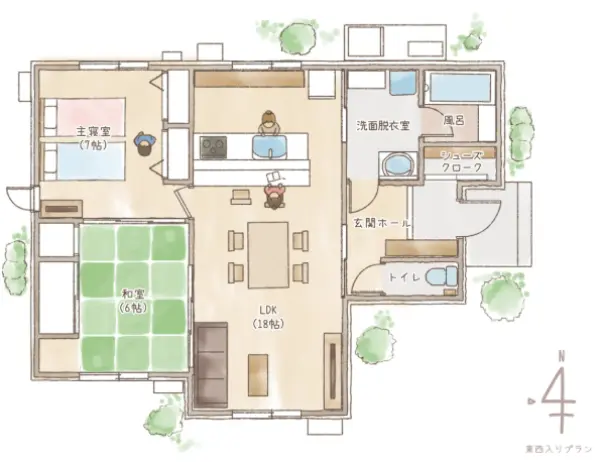
Building a single-story house with Ichijo Komuten for around 15 million yen (base price) is quite doable if you go with one of their standardized models like "HUGme" or "i-smile."
What kind of house can you get for 15 million yen with an Ichijo single-story home? A look at an actual floor plan from their cheapest plan, "HUGme"
https://mirin-ichijo.com/hiraya1500/
How much would you have to strip out to build it for 10 million?
Even a smallish single-story house needs at least 20 million.
If a single-story house costs 20 million, then only rich people can afford it lol
With 20 million, even a two-story house can only be a small one.
Even around 20 tsubo (~66 sqm), at 1.5 million yen per tsubo that's already 30 million.
Setting aside the "only rich people can afford it" debate, you just can't build for 10 million these days.
Even a single-story house with a 20-tsubo footprint would definitely run past 20 million with Ichijo.
Three years ago you might've shaved maybe 3 million off that, but even then, 10 million was never realistic for an Ichijo-tier builder.
Recommended floor plan for 1-3 person households
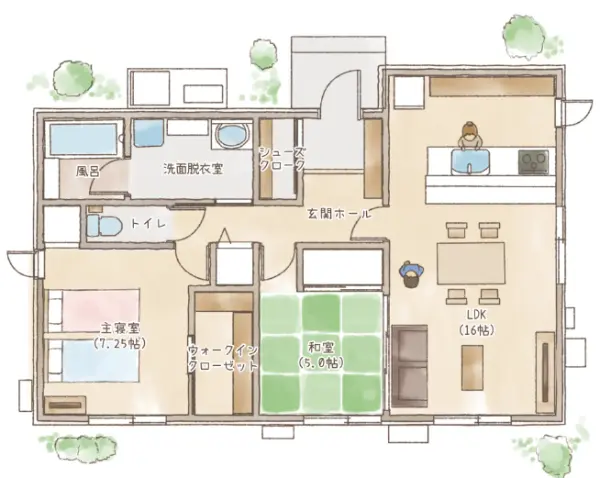
Recommended floor plan for 2-4 person households
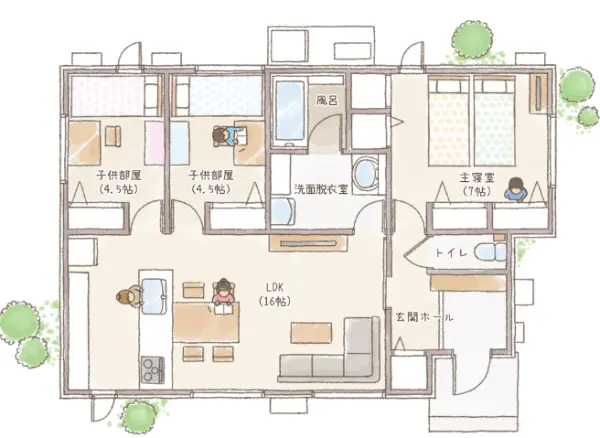

Looks like a streamer's house lol
With mid-sized trees, the roof ends up hidden by the branches apparently.
Looks like it'd stay cool in summer.
Reinforced concrete is the standard in Okinawa, huh.
The reason reinforced concrete (RC) construction is so common for Okinawan houses comes down largely to the harsh natural environment — typhoons, salt damage, and termites — along with historical factors from the postwar period.
It's said that about 90% of homes there are built with concrete.
For the cat: a heater, plus clear glass and a shelf so the cat can watch the outside through the window.
Land's expensive, so I figured single-story houses were only for rich people,
but then I realized this thread's full of people from the countryside — makes sense now.
I feel like single-story houses were also common even before the Showa-era high-growth period.
Mine's 70 years old — I keep patching leaks and fixing the floor whenever it gives out, and the ground has shifted enough that there are cracks in the support posts, but the land itself is 10,000 square meters.
Background and Key Points of This Discussion
This survey, conducted by Recruit-operated SUUMO, tallies the share of single-story houses among newly built wooden detached homes by prefecture. The backdrop includes the 2016 Kumamoto earthquake and the 2024 Noto Peninsula earthquake — indeed, Kumamoto’s rate climbed from 25.3% in 2015 to 37.4% in 2025, while Ishikawa’s grew roughly eightfold. That said, it’s worth noting that “single-story means earthquake-resistant” isn’t strictly accurate: these houses merely tend to resist shaking better thanks to their low center of gravity and simple structure, while actual seismic resistance still comes down to design and construction quality. As pointed out in the thread, the Building Standards Act actually mandates structural calculations (allowable stress calculations) for buildings of three stories or more, meaning two-story buildings and under can sometimes get by with simpler inspections. The popularity of single-story houses isn’t just about earthquake preparedness, either — it also reflects the rise of single- and small-person households and the ease of mobility in old age, alongside the very real constraint that single-story homes are simply impractical in cities where land is expensive. The bottom-ranked areas, Tokyo (1.9%) and Kanagawa (3.9%), reflect exactly this land-cost reality.
*This article is compiled as an excerpt and summary of the 5ch (News Flash+) thread “[Housing] Nationwide single-story rate hits 20%, seismic resistance draws attention — new detached homes, especially high in Kyushu.”
Leave a Reply