From our other sites
The story
Tesla has unveiled its purpose-built driverless taxi, the “Cybercab,” in Japan for the first time. The vehicle has no driver’s seat, steering wheel, or pedals, and has already begun operating in parts of Texas this month, though a timeline for Japanese service remains undecided. Thread reactions ranged widely — from safety concerns about how to stop the car in an emergency, to comments citing Waymo’s track record and arguing it’s “already safer than human drivers,” to skepticism about whether the technology has been proven on Japan’s narrow roads and in snowy conditions. Many also wondered whether fares would actually be cheaper, and voiced regulatory skepticism that Japan’s transport ministry would ever approve it.
Sept 11 (Fri), 11:14 AM JST
Yomiuri Shimbun Online
U.S. electric vehicle giant Tesla unveiled its purpose-built driverless taxi, the “Cybercab,” in Japan on the 11th. The vehicle has no driver’s seat, steering wheel, or pedals. Service began in parts of Texas this month, but domestic operation in Japan remains undecided for now.
Source: news.yahoo.co.jp / Original article here
What people said
Adding something like that would be dangerous — humans are the most dangerous part of the equation.
>Reminds me of Total Recall.
Now I want to rewatch Total Recall.
It's on U-NEXT lol
Gonna start with the 1990 Schwarzenegger one.
Thanks for the reminder (a pun: writing it "arigaton" using the kanji for "ton," i.e. "thanks a ton").
Is there one that's different too — the sign-language version or something? I'd want to watch it if it's on Netflix.
Hit the self-destruct switch.
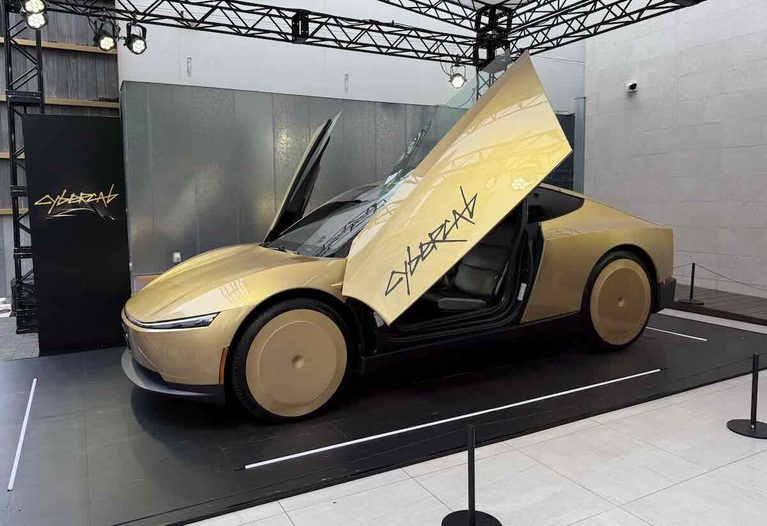
The logo looks like the Cyberpunk 2077 logo.
This car uses a rare-earth-free motor that even Japan hasn't managed to build yet.
"Completely rare-earth-free" motor — its true value lies in escaping China-dependent supply chains, Chinese media reports
https://www.recordchina.co.jp/b992150-s25-c20-d0193.html
> Regarding the new "completely rare-earth-free" motor Tesla announced, the report says its real value isn't a technical leap forward but the added freedom it gives vehicle design and the shift away from dependence on China-centered supply chains.
Could they build this even with a 10-year head start? Not happening even in 100 years, lol
There was some YouTube video of Nissan doing something with generative AI — curious what that actually amounts to in practice.
But since it's not driving on public roads without a person aboard, Japan being 10 years behind doesn't change.
It's Level 4, so "brace yourself."
https://pbs.twimg.com/media/BynF9w6CUAIR6o9.jpg
This is definitely gonna screw something up, lol
I'm not taking that risk — you take it instead.
Even at this limited-operation stage, it's already safer than most drivers on Earth. Waymo alone has driven over 3 billion km with a lower accident rate than humans.
Does it have a track record on roads like Japan's — narrow, winding streets, roads where the lane paint has half worn away, snow-covered roads, that kind of thing?
They say its accident rate is lower than humans', but I wonder how that holds up once you exclude high-risk groups like the elderly and young drivers, and compare it against middle-aged men or professional taxi drivers instead.
It's not in this article, but apparently two taxi companies are involved, so… read between the lines.
If they did that right now it'd wreck the market and taxi drivers would come after them with torches. They'll probably price it just cheap enough that skipping the tip on a rideshare feels like the better deal.
Priced high because it's scarce.
If it could do fully autonomous driving on the highway alone, I might buy it even at a high price. My Nissan Note's ProPilot sometimes tries to veer off in a weird direction and freaks me out — and it just gives up the moment the rain gets heavy.
But it's gonna be pricey thanks to Trump's tariffs, lol
At that point it's the same as any car — the person inside just gets out, no?
It's not gonna drive into a flooded underpass in the first place, lol
There's already a bus trial running — fixed route though.
You need the law in place before you can even run a trial. Scrambling to react after an accident's already happened is a foolish approach. If it's genuinely too hard to anticipate, that's one thing, but everyone knows tragic fatal accidents are inevitable as long as cars are on the road, so the response needs to be worked out in advance.
Won't happen in Japan — no country in the world has approved Tesla's self-driving taxi. Even in the U.S. it's only allowed in one limited part of Texas.
So tell me which country actually has approved it, then?
Background and Key Points of the Debate
The Cybercab is a fully driverless, purpose-built vehicle that began operating in parts of Austin, Texas in September 2026; the timing and areas for Japanese service remain undecided. In the debate over self-driving taxis, Waymo has logged over 3 billion km on public roads with a lower accident rate as its track record — though it’s easy to overlook that the numbers look very different depending on whether they’re compared against all drivers or against a narrower age bracket. Since operation in Japan hinges on new legislation and approval from the transport ministry, Tesla’s U.S. track record won’t necessarily speed up domestic rollout. The thread shows the claim that it’s “safer than humans” sitting alongside cautious voices noting that “its performance on Japan’s narrow roads and in snow remains unproven” — a reminder that how mature the technology is and how well it adapts to legal systems and local conditions are two separate questions.
*This article is compiled as an excerpt/summary of the 5ch (Breaking News+) thread “[EV] Tesla Unveils Handle- and Pedal-less Driverless Taxi “Cybercab” in Japan for First Time — Domestic Operation Timing Still Undecided.”
Leave a Reply