Category: Society

  • JR Lines in Kanto Suspend First Trains for Track Inspections After Earthquake — No Restart in Sight as of 5 AM

    In the early hours of the 23rd, an earthquake that registered a maximum intensity of 5-lower in Ibaraki, Tokyo, Saitama, and other areas led JR East to suspend the first trains of the day on many conventional-line sections across the Kanto region. On the thread, users traded updates on the status of individual lines like the Musashino Line and Utsunomiya Line, while also repeatedly criticizing JR East’s inspection regime, which some blamed on cost-cutting.

    8/23 (Sun) 5:13 AM

    TBS NEWS DIG

    Here’s the latest on the earthquake’s impact on rail service. Around 2 a.m. today (the 23rd), an earthquake registering a maximum intensity of 5-lower struck Ibaraki, Tokyo, Saitama, and other areas. As a result, JR East will suspend the first trains of the day on conventional lines across many sections of the Kanto region for track inspections and other safety checks.

    Source: topics.smt.docomo.ne.jp / Original article here

    2AnonymousAug 23, 2026 07:56
    Cars really are the best, after all
    69AnonymousAug 23, 2026 08:22
    Re: #2
    Watch out for flooding
    113AnonymousAug 23, 2026 08:38
    Re: #2
    Nah, bikes are the real champ
    134AnonymousAug 23, 2026 08:43
    Re: #2
    You've got two perfectly good legs, don't you?
    Walk.
    7AnonymousAug 23, 2026 07:58
    Only a few sections are actually affected, no big deal
    11AnonymousAug 23, 2026 08:00
    Re: #7 ▼Utsunomiya Line and Takasaki Line: "Tokyo Station – Omiya Station"
    Wait, what?
    14AnonymousAug 23, 2026 08:01
    Re: #11
    If the Saikyo Line and Keihin-Tohoku Line are running on that stretch, no problem right?
    60AnonymousAug 23, 2026 08:18
    Re: #14
    The Keihin-Tohoku Line is stopped
    86AnonymousAug 23, 2026 08:29
    Re: #14
    The Saikyo Line runs a different route and doesn't even go to Tokyo
    27AnonymousAug 23, 2026 08:06
    West of Aichi, an intensity of 8 has never once been recorded —
    but in Kanto, intensity 8 has hit repeatedly on a 100-year cycle lol
    45AnonymousAug 23, 2026 08:13
    Re: #27
    What's this 'intensity 8' supposed to be?
    77AnonymousAug 23, 2026 08:25
    Re: #27
    Intensity 8 has never been observed anywhere in Japan — it doesn't even exist, lol (the Japanese seismic scale tops out at 7)
    39AnonymousAug 23, 2026 08:12
    Waking everyone up in the middle of the night for a 5-lower and still not running trains — how dumb is that
    Out in the countryside, a 5-lower and trains are back to normal within the hour
    44AnonymousAug 23, 2026 08:13
    Re: #39
    Isn't the whole reason you live in Tokyo that you don't want to be out in the countryside?
    51AnonymousAug 23, 2026 08:14
    Re: #39
    Even on the morning of the Great Hanshin earthquake, the Kintetsu line was still running lol
    Though only the limited expresses and locals — the regular expresses never showed up at all
    64AnonymousAug 23, 2026 08:19
    Re: #39
    You'd probably say the same thing even at a 6-lower

    Though note that an AEON store literally blew up during a 6-lower quake
    65AnonymousAug 23, 2026 08:19
    They probably can't run anything until every piece of rail infrastructure — tracks, trains, the power supply, the stations, all of it — has been fully checked for safety

    The shared assumption that any accident becomes the operator's fault got cemented after the AEON Mall Kumamoto incident
    71AnonymousAug 23, 2026 08:22
    Re: #65
    So everyone piled on AEON, and the result was less convenient transit
    And now they're complaining recovery is too slow

    That whole cycle, right there — that's Japan for you
    68AnonymousAug 23, 2026 08:21
    Well, being overly cautious doesn't keep the world running either

    Stopping trains to inspect over a quake this minor probably won't last — it's just for now

    Money, money, money > safety, apparently
    73AnonymousAug 23, 2026 08:23
    Re: #68
    They do it because an accident ends up costing way more money than the inspection does
    79AnonymousAug 23, 2026 08:25
    Re: #68
    Tell that to the people who piled on AEON over their incident
    This is on them
    76AnonymousAug 23, 2026 08:24
    Re: #73
    JR East doesn't think that far ahead — it's 100% short-term thinking, always
    80AnonymousAug 23, 2026 08:26
    Re: #76
    If they were only thinking short-term, they wouldn't bother inspecting at all
    93AnonymousAug 23, 2026 08:32
    Re: #80
    They're always cheaping out on inspections — that's exactly why that overhead-wire trouble the other day knocked things out for a whole day
    They get stopped by garbage-tier trouble all the time, so don't even talk
    95AnonymousAug 23, 2026 08:33
    Huh?
    If you're a working adult, you just walk to work when the trains stop for an earthquake, right?
    That's just common sense
    99AnonymousAug 23, 2026 08:33
    Re: #95
    A competent working adult anticipates the earthquake and just stays overnight at the office
    Every day
    100AnonymousAug 23, 2026 08:34
    Re: #95
    There's this thing called the Tsukuba Express, you know (a rail line built to keep running through disasters)
    109AnonymousAug 23, 2026 08:36
    Re: #95
    Sup, Sato-san (a nod to a recurring meme figure from old 5ch earthquake threads)
    111AnonymousAug 23, 2026 08:38
    The Musashino Line isn't running from Nishi-Funabashi toward Tokyo
    It's doing a partial run toward Minami-Funabashi, between Nishi-Funabashi and Minami-Funabashi
    Everyone's swarming that section and it's chaos — the platform is packed
    The Musashino Line is also doing a partial run between Nishi-Funabashi and Yoshikawa-minami
    Not sure if any trains are making it all the way to Fuchu-Honmachi
    118AnonymousAug 23, 2026 08:39
    Re: #111
    Guess it's a silver lining that it's a day off, if anything?
    150AnonymousAug 23, 2026 08:49
    Re: #111
    I've got work though — and all the people heading to Disney ("Mouse-y," slang for Tokyo Disneyland), Makuhari, or events in Minami-Funabashi are creating a bottleneck. Total pandemonium
    119AnonymousAug 23, 2026 08:40
    Re: #113
    When you factor in the trouble it causes other people, biking isn't such a great option either
    142AnonymousAug 23, 2026 08:47
    Re: #119
    Hey, hurry up and move that flooded car out of the way lol
    ( ̄∀ ̄)
    209AnonymousAug 23, 2026 09:31
    Re: #119
    Still doesn't cause as much trouble to others as those 'car scum' drivers do (a common slur for inconsiderate motorists)

    Background and Key Points

    JR East suspended the first outbound trains of the morning across many conventional lines in the Kanto network after a magnitude quake registering intensity 5-lower on the Japanese seven-point scale (shindo), which tops out at 7 — the “intensity 8” floated in the thread doesn’t exist and was quickly corrected by other posters. Shindo 5-lower is a mid-tier reading that can still misalign rails, damage overhead wires, or shift ballast, so operators typically run inspection walks or track cars along the entire affected section before clearing any train to move; on dense Tokyo-area trunk lines like the Utsunomiya, Takasaki, Musashino, and Saikyo, that means checking many kilometers of interlaced track before any of them reopen, hence the 5 AM “no restart in sight” status.

    The thread’s real fault line wasn’t whether trains should have stopped — nobody defended running unchecked track after a quake — but whether JR East’s inspection process is appropriately careful or symptomatic of underinvestment. One camp pointed to a recent overhead-wire failure as evidence of chronic corner-cutting; another argued the opposite, that a full-line safety check after any quake is unavoidable liability management, invoking the 2016 AEON Mall Kumamoto ceiling collapse as the reason Japanese operators now default to maximal caution rather than risk being blamed for an accident.

    What outside readers likely miss is scale: this wasn’t one line closing, but a temporary, systemwide freeze across multiple JR East trunk routes serving millions of Sunday commuters and Tokyo Disney-bound travelers, which is why alternate lines like the Musashino got swarmed rather than absorbing the overflow smoothly. The thread never mentioned that JR East publishes formal post-quake inspection thresholds tied to shindo readings — the delay wasn’t arbitrary caution but a scale-triggered protocol.

    *This article is compiled from excerpts and a summary of the 5ch (Breaking News+) thread “[Intensity 5-Lower] JR Lines in Kanto Suspend First Trains for Track Inspections After Earthquake — No Restart in Sight as of 5 AM.”

  • Was the ‘Evil’ in Yamatai and ‘Lowly’ in Himiko Actually an Insult? 5ch: ‘Ancient China’s Nastiness in Deliberately Choosing Debasing Characters’

    There’s a theory that China chose the derogatory characters “邪” (evil) and “卑” (lowly) in “Yamatai” and “Himiko” to look down on Japan — but a new theory has been introduced arguing these characters were simply picked to transcribe the sounds phonetically.

    On 5ch, however, pushback came fast: “If it were just about matching the sound, simple characters even a child could write would have been enough,” and “The fact that they went out of their way to pick a character meaning ‘lowly’ says it all about ancient China’s nastiness.” The discussion expanded into Sinocentrism and the derogatory names given to peripheral peoples like the Emishi and the Nanban (“southern barbarians”).

    Have you ever wondered, on hearing “Yamatai” or “Himiko,” why characters with such negative meanings as “邪” (evil) and “卑” (lowly) were used? Among history buffs, it’s often said that China looked down on Japan and deliberately chose these characters. But when you examine the characters used for phonetic transcription using the ancient Chinese pronunciation dictionary Guangyun as a clue, a surprising fact emerges: “邪” and “卑” were likely chosen not to insult Japan, but simply to represent sounds. So what exactly does this mean? *This article is an excerpt, edited from the section written by Ikuya Tanaka in “Big Questions About Kanji: The World of Words You Use Every Day but Don’t Really Know,” edited by the Japan Kanji Aptitude Testing Foundation (Magazine House).

    (omitted)

    Names like “Yamatai” and “Himiko,” which rendered Japanese proper nouns of the time in Chinese characters, deliberately used characters with negative meanings such as “邪” (evil) and “卑” (lowly). This is because of Sinocentrism (the worldview that China is the center of the world and barbarians live on its periphery) — which is why characters with such negative meanings were used.

    Source: diamond.jp / Original article here

    3AnonymousAug 22, 2026 23:57
    Everyone already knows the phonetic-transcription thing is a given, no need to act like it's some big discovery now.
    Out of all the characters that could've matched the sound, they deliberately picked the ones with bad meanings, right?
    18AnonymousAug 23, 2026 00:07
    Re: #3
    Exactly, the nastiness of ancient China deliberately using a character meaning "lowly" —
    that's the whole story.
    38AnonymousAug 23, 2026 00:14
    Re: #3
    Right.
    Same with "Mongol" (蒙古) —
    "蒙" carries the meaning of "blind/benighted" (an old, now-discriminatory term), implying something backward and archaic.
    70AnonymousAug 23, 2026 00:28
    Re: #3
    Exactly right — if it were purely about matching sounds, they'd have used simple, low-stroke-count characters, the kind used as furigana reading aids when kids are first learning kanji.
    11AnonymousAug 23, 2026 00:04
    Well, if your main export was slaves, of course you'd get looked down on.
    160AnonymousAug 23, 2026 01:12
    Re: #11
    The word for slave (奴婢, nuhi) already existed back then, so the "seikou" (生口, the people sent as tribute) seem to have been more like laborers or servants. That said, it was human trafficking, no argument there.
    14AnonymousAug 23, 2026 00:05
    https://www.kosho.or.jp/upload/save_image/12011690/20240126144439617789_9d902c1be5efa843e3d4087e130855c6.jpg
    22AnonymousAug 23, 2026 00:08
    Interesting search result. Searched "Emishi" (蝦夷).
    —
    Japan's adaptation of Sinocentrism ("Little Sinocentrism")
    Ancient Japan (the Yamato court) applied China's worldview — "the emperor is the center of the world and rules over the uncivilized peripheral peoples" — to the Japanese archipelago. This is called "Little Sinocentrism" or "Japanese-style Sinocentrism."
    The derogatory term "Emishi" (毛人, "hairy people"): copying how China labeled surrounding peoples with characters like "東夷" (eastern barbarians) and "北狄" (northern barbarians), the Yamato court called the people of the Tohoku region who wouldn't submit to it "毛人" or "蝦夷" (Emishi), casting them as culturally backward.
    The idea of "civilizing imperial rule" (王化, oka): it was held to be righteous for the emperor's virtue (superior culture and etiquette) to civilize and subjugate these peripheral "uncivilized people."
    34AnonymousAug 23, 2026 00:12
    Re: #22
    That's right.
    Kyoto's "rakuchu/rakugai" (inside/outside the capital) distinction is Sinocentrism too.
    Calling the Jomon people "i" (夷, barbarian) was Sinocentrism.
    Calling Westerners "Nanban" (southern barbarians) was Sinocentrism too.
    66AnonymousAug 23, 2026 00:27
    Re: #34
    To begin with, Kyoto's cityscape was modeled on China's Luoyang, and the "洛" (raku) you hear in terms like rakuchu and rakunan comes straight from Luoyang's "洛."
    Kyoto people have a pretty strong streak of Sinocentrism themselves.
    73AnonymousAug 23, 2026 00:29
    Re: #34
    Knowing Re: #1, they'd probably spin "ban" (蛮, barbarian) as positive too — "just a coincidence," they'd say.
    46AnonymousAug 23, 2026 00:16
    If they're saying that seriously, they really don't know much, lol
    49AnonymousAug 23, 2026 00:18
    Mesopotamian civilization was already obsessing over celestial bodies and the sun and building pyramids back in 4000 BC. (´・ω・`)
    Meanwhile Japan was off chasing mammoths and eating them.
    51AnonymousAug 23, 2026 00:20
    Re: #49
    Yeah, it's kind of embarrassing when you think about it —
    everything civilized came over from China and Korea, after all.
    60AnonymousAug 23, 2026 00:22
    Re: #49
    If you're going to say that, you could call basically any country dumb by that logic.
    50AnonymousAug 23, 2026 00:19
    The Chinese looked down on the white people who arrived by ship from Europe too, calling them "Nanban" (southern barbarians).
    57AnonymousAug 23, 2026 00:21
    Re: #50
    Paper money, the compass, paper itself, printing, gunpowder — they all actually originated on the Chinese mainland.
    Most of it came from the Han Chinese.
    54AnonymousAug 23, 2026 00:21
    They believed the superstition that Beijing was the center of the world and civilization declined the further you got from it, so of course they'd think that way.
    But yeah, in Himiko's era, mainland China probably was more advanced.

    Still, by the 6th century, in the reign of Empress Suiko (a female emperor), Japan declared that the Chinese emperor and the Japanese emperor were equals.
    A few hundred years after that, Japan decided there was no point going to China anymore and abolished the kentoshi (envoy missions to Tang China).
    So maybe Japan's been on top ever since.
    68AnonymousAug 23, 2026 00:27
    Re: #54
    Writing (kanji) had only just been introduced to Wa (Japan), so they sent off a "state letter" pretty casually…
    and ended up angering Emperor Yang of Sui. After that they were too scared to send envoys for a while.

    So they just pretended the reply letter had been lost.
    75AnonymousAug 23, 2026 00:29
    Re: #68
    Guess they've always been thin-skinned.
    56AnonymousAug 23, 2026 00:21
    "King of Na, [Vassal] of Wa, [Under] Han" (漢委奴国王)


    There's a theory that "委" — the character "倭" with the "person" radical dropped — was used to mark the Wa as something less than human.
    65AnonymousAug 23, 2026 00:26
    By the way, what did the envoys from Japan actually give the Chinese emperor as gifts?
    He could get his hands on pretty much anything in the world already.
    Was there anything from Japan at the time actually good enough to present to a superior?
    76AnonymousAug 23, 2026 00:30
    Re: #65
    Maybe the point wasn't the gift itself, however trivial, but the act of offering tribute at all —
    a show of submission.
    81AnonymousAug 23, 2026 00:30
    Re: #65
    4 male "seikou" (生口, tribute laborers)
    6 female "seikou"
    2 bolts, 2 jo of speckled cloth

    People, basically — the main tribute was essentially something close to slaves.
    98AnonymousAug 23, 2026 00:35
    Re: #65
    Probably nothing much worth mentioning.
    It probably wasn't until the cupellation method (haifuki-hō) arrived from Korea and Japan started exporting silver to China that things changed. By the 17th century, Japanese-produced silver apparently accounted for a quarter to a third of world output.
    148AnonymousAug 23, 2026 01:05
    "Northern Di, Southern Man, Western Rong, Eastern Yi" (北狄南蛮西戎東夷) —
    they didn't even regard the surrounding peoples as human.
    But "倭" (Wa) does have the "person" radical attached to it.

    There's a theory that "委" meant something like "shorty."
    Even "Wei" (魏, the Chinese kingdom's name) is "oni" (鬼, demon) plus "委" — that looks like a far worse character than "Wa."
    149AnonymousAug 23, 2026 01:07
    Re: #148
    "Oni" (鬼) isn't necessarily a bad meaning —
    it's just something to be feared/revered.
    Treating another people as human at all was a big deal in itself.
    152AnonymousAug 23, 2026 01:07
    Re: #148
    And on top of that, giving them the very same character "委" —
    that's practically gold-seal-level treatment, honestly.
    185AnonymousAug 23, 2026 01:24
    Re: #148
    I asked an AI, and apparently "Wei" (魏) isn't a bad meaning —
    since its radical is "oni" (鬼, ghost/demon), that side of the meaning is supposedly the stronger one.
    154AnonymousAug 23, 2026 01:07
    Re: #149
    Using "oni" in a positive sense is a uniquely Japanese thing.

    In China it only ever has a negative meaning.
    That's why they say things like "Riben guizi" (日本鬼子, "Japanese devil").
    161AnonymousAug 23, 2026 01:12
    Re: #154
    Originally it expressed dignity and grandeur.

    Otherwise, why would they use it as the name of a kingdom?
    170AnonymousAug 23, 2026 01:18
    Re: #154
    In Japan the image is a musclebound guy with an iron club wearing a tiger-skin loincloth, but apparently in China the image is more like a ghost or specter.
    With "鬼子" (guizi) it apparently carries the nuance of being some kind of monster, not the same as a human.
    Probably closer to the nuance of a goblin or an orc.
    155AnonymousAug 23, 2026 01:08
    The character "倭," used to represent Japan,
    carries meanings like "short" and "submissive" —
    so, well, you can figure it out.
    157AnonymousAug 23, 2026 01:10
    No, that's not really it…

    Xianbei, Xiongnu, Yamatai and Himiko —
    given names like that, there must have actually been something distinctive about them, even from their point of view, back then,
    in actual Japan.

    Surely it's about time we reached a proper scientific conclusion on this.
    159AnonymousAug 23, 2026 01:12
    Re: #155
    Chinese people have always been big, historically — Lü Bu, Guan Yu, Xiang Yu, Wang Qi…
    Maybe it's because, being connected by land, western blood got mixed in too.
    163AnonymousAug 23, 2026 01:13
    Re: #155
    Re: #157
    That's why I'm saying, think about why "倭" has the "person" radical in it.
    And on top of that, they were given the very same "委" character as in "Wei."
    166AnonymousAug 23, 2026 01:17
    Re: #155
    "Submissive" meant something different back then — it carried the sense of being "gentle and courteous."

    Background and Key Points

    The names “Yamatai” (邪馬台国) and “Himiko” (卑弥呼) come from the “Wajinden” section of the Chinese chronicle Sanguozhi (Records of the Three Kingdoms, compiled ~3rd century CE), the earliest written account of the Wa people who inhabited the Japanese archipelago before Japan had its own writing system. Because the Wa left no records of their own, every proper noun survives only in the form Chinese scribes chose to write it. That mattered because China’s worldview was explicitly Sinocentric: peripheral peoples were routinely labeled with dehumanizing terms like 東夷 (eastern barbarians), 北狄, 南蛮, and 西戎, and Japan itself was later called “Wa” (倭), a character carrying connotations of shortness or submissiveness.

    The thread’s actual fault line isn’t over whether Sinocentrism existed — everyone agrees it did — but over intent in this specific case: did scribes deliberately reach for insulting characters (邪=”evil,” 卑=”lowly”) to belittle Yamatai and Himiko, or did they simply grab whatever characters matched the sound, per the article’s phonetic-reconstruction argument using the Guangyun rhyme dictionary? Posters largely rejected the “just phonetics” reading, noting that plenty of neutral, simple-stroke characters shared those same sounds, so the choice still reads as pointed.

    What the thread never addresses is a dating problem: Guangyun is a Song-dynasty compilation from roughly 1,000 years after the Wei-era transcriptions were made, so using it to reconstruct 3rd-century pronunciation is itself an approximation, not hard proof of phonetic intent either way — the debate may be unresolvable with the evidence actually cited.

    *This article is compiled from excerpts and a summary of the 5ch (Breaking News+) thread “[History] Did China Look Down on Yamatai and Himiko? The Surprising Reason Behind the Choice of “邪” and “卑”.”

  • Police Academy Bans Shouting at Cadets, Leaving Instructors Struggling to Adapt — 5ch: ‘Can They Actually Handle the Streets?’

    It’s been reported that Hyogo Prefectural Police Academy has shifted away from its old style of screaming instruction, moving instead toward a more “supportive” approach that includes exchange diaries between cadets and instructors — sparking discussion on 5ch’s Newsflash+ board.

    The thread saw a clash between worried voices asking “can cadets coddled like this really hold their own against violent criminals and yakuza?” and defenders arguing “strict training and power harassment are two different things” and “harassment isn’t education” — with the discussion spiraling out into debates about Gen Z and comparisons with policing overseas.

    Until just a few years ago, instructors’ angry shouts echoed through the halls of Japan’s police academies. But this is now the “compliance era.” At Hyogo Prefectural Police Academy, which shifted to a more “supportive” style of instruction last year, instructors have been struggling with how to convey the harsh realities of the job without crossing the line into harassment. On graduation day, what were the instructors’ final words to their students?

    ■ “You’re the only one who can’t do it!” — Has the once shout-filled police academy really changed that much!?

    On July 31, Hyogo Prefectural Police Academy held its graduation ceremony. The graduates will now head into the field, carrying the heavy responsibility of protecting the peace of their communities.

    Source: news.yahoo.co.jp / Original article here

    5AnonymousAug 22, 2026 21:58
    Come on, come on, come on.
    Can these softies actually handle criminals?
    Yakuza are scary, you know?
    Shouldn't they be used to getting yelled at?
    116AnonymousAug 22, 2026 22:53
    Re: #5
    The yakuza switched to a no-shouting policy way before the cops did, just to secure recruits.
    173AnonymousAug 23, 2026 00:50
    Re: #5
    When they're actually throwing their weight around, I bet they'll do it with a totally cool, straight face.
    9AnonymousAug 22, 2026 22:00
    If they're coddled this much, won't they turn into spineless cops?
    Can they really go toe-to-toe with violent criminals out in the field?
    36AnonymousAug 22, 2026 22:13
    Re: #9
    Congratulations, you've just built a wrongful-conviction machine.
    16AnonymousAug 22, 2026 22:03
    Apparently parents have been filing complaints, that's why.
    196AnonymousAug 23, 2026 01:29
    Re: #16
    In cases that actually went to court, they really did call in the parents and grill them hard, telling them to make their kid quit.
    Apparently it's standard practice for police to bring parents in voluntarily and interrogate them as if the father “manufactured a defective product” and the mother “gave birth to industrial waste.”
    So the parents fight tooth and nail for their own honor too, which is apparently why so many of these cases fail to settle and end up going all the way to the Supreme Court.
    17AnonymousAug 22, 2026 22:04
    Re: #1

    The term “power harassment” (パワハラ/pawahara) itself is a made-in-Japan English word (wasei-eigo).
    It's a coinage made up by a private HR consulting firm — only used in Japan.

    America doesn't have anything like that.
    169AnonymousAug 23, 2026 00:40
    Re: #17
    “Sexual harassment,” though, actually came from America.
    Then again, over there you can get fired way more easily.
    37AnonymousAug 22, 2026 22:13
    Are you an idiot?

    On the job, cops deal with people who couldn't care less about “compliance.”
    41AnonymousAug 22, 2026 22:14
    Re: #37
    No.
    The police are an organization that destroys the lives of people who did nothing wrong.
    47AnonymousAug 22, 2026 22:17
    If they're trained like this, won't they burst into tears the moment a suspect gets in their face?
    49AnonymousAug 22, 2026 22:18
    Re: #47
    “I was harassed by a violent criminal, so I'm reporting it to the Labor Standards Office.”
    48AnonymousAug 22, 2026 22:18
    Seriously, can they face down violent criminals like this?
    Is the classic tough-guy interrogation shout “This is Osaka, ya hear!” (a stereotypical hard-nosed Osaka-cop catchphrase) going to become a dying tradition?
    50AnonymousAug 22, 2026 22:18
    Re: #48
    Guess it'll turn into a softer “This is Osaka, okay?” instead.
    57AnonymousAug 22, 2026 22:24
    Surely police, firefighters, and the Self-Defense Forces need to keep some level of strictness to weed out unsuitable recruits during training, or they'll end up hiring some seriously bad apples…
    75AnonymousAug 22, 2026 22:31
    Re: #57
    They've already been hiring bad apples like crazy, it's bad!
    59AnonymousAug 22, 2026 22:25
    There are way more skinny, out-of-shape young cops than before.
    I walked into a certain police headquarters and there was some thug
    sprawled out on the lobby bench with his shoes still on, like he owned the place,
    and nobody even said anything to him.
    They're being completely disrespected.
    You can really feel the staffing shortage.
    89AnonymousAug 22, 2026 22:38
    Re: #59
    But aren't today's thugs less rough around the edges than they used to be too?
    82AnonymousAug 22, 2026 22:33
    Strict training and power harassment are two different things.
    Power harassment is nothing but personal emotion.
    It's totally possible to run strict training that isn't just someone venting their feelings by tormenting people — the fact that police can't manage that is just plain stupid.
    85AnonymousAug 22, 2026 22:35
    Re: #82
    Whether something counts as harassment
    is decided by the “victim,” you know.
    98AnonymousAug 22, 2026 22:42
    Re: #82
    American guy: “Power harassment? What's that? We don't have anything like that in America.”
    95AnonymousAug 22, 2026 22:39
    Well, to put it bluntly, I think it's fine if someone wants to use power harassment —
    as long as they're prepared for the fact that if everyone they harass quits and nobody sticks around, and the organization can't function because of the staffing shortage,
    that's on the harassers and the brass themselves, self-inflicted.

    That said, unlike a normal company, police have the special condition of having to deal with violent criminals who are ready to fight — that makes it tricky.
    And as a kind of dry run for that, if someone's spirit breaks just from an instructor being tough on them, they honestly aren't cut out to be a cop.
    106AnonymousAug 22, 2026 22:46
    Re: #95
    Foreigner: “What is this ‘power harassment'? Another Japanese-made word? Japan really is its own little Galápagos, huh.”
    107AnonymousAug 22, 2026 22:46
    “I'm going to need you to leave the academy.” “Understood.” “Wait, h-hold on!” (echoing the famous whiny catchphrase from the drama Hana Yori Dango)
    124AnonymousAug 22, 2026 23:02
    Re: #107
    What actually gets evaluated is just the headcount at enrollment, so it doesn't matter if people quit afterward.

    There are plenty of people who want to become cops anyway.
    134AnonymousAug 22, 2026 23:25
    The police aren't so different from the military, are they?
    Can they really stand up against outlaws?
    135AnonymousAug 22, 2026 23:27
    Re: #134
    Going forward, police are probably going to get more incompetent — like firing their guns the second they get scared, or needing ten officers to surround one raving addict and still not being able to subdue him…
    140AnonymousAug 22, 2026 23:39
    Is this place full of nothing but Showa-era relics who don't even understand that “harassment” means “harassment”?
    Go ahead and give them strict training and education.
    But harassment isn't training or education.
    144AnonymousAug 22, 2026 23:51
    South Korea's mandatory military training is like this now too —
    I was shocked at how soft it's gotten.
    160AnonymousAug 23, 2026 00:27
    Re: #144
    If the North Korean army came marching south, they'd probably just get scared and run.
    170AnonymousAug 23, 2026 00:40
    Re: #1
    Hey now, if they don't nurture them carefully the police force will shrink and we'll end up living in Gotham City lol

    https://newsdig.ismcdn.jp/mwimgs/1/8/750w/img_1824bf0d8873f45b8983b2f909e41949244995.jpg
    178AnonymousAug 23, 2026 00:53
    >“Speak up loud and give it your all! Fight!”

    >More like finding the right way to flip their switch

    >Some students even cry the first time they handle a handgun

    >Instructor: “I won't lose to these young guys yet” — worked hard so as not to be outdone

    Sounds like it's the instructors who have it rough now lol
    Pretty soon nobody's going to want that job either
    187AnonymousAug 23, 2026 00:57
    Re: #178
    Line three — back in the day, a student like that would've been expelled.
    Well, cop academy (“poli-ko,” slangy shorthand for the police) isn't about raising an elite, so I guess anybody'll do.
    200AnonymousAug 23, 2026 01:34

    Check out the intensity of Osaka Prefectural Police raiding a yakuza office!

    Background and Key Points

    Japan’s prefectural police forces each run their own residential training academy, and recruits typically spend six months to a year living under an instructor’s direct supervision before their first assignment — a structure inherited from a pre-war and postwar culture that treated harsh discipline as inseparable from readiness for the job. What’s changed is not the academy system itself but the legal and cultural climate around it: Japan’s Power Harassment Prevention Act, phased in for large employers in 2020 and extended to smaller organizations in 2022, obliges institutions — including police, which had long been treated as a special case — to formally document and prevent abusive supervision. Hyogo’s shift to “exchange diaries” and softer instruction is one prefecture’s local response to that broader legal pressure, not an isolated policy experiment.

    The thread’s real fault line wasn’t over whether harassment is bad — nearly everyone agreed on that — but over whether shouting-based training was ever actually about harassment, or whether it was functioning as a proxy stress test for a job that involves confronting armed and violent people. Posters defending the reform insisted strict training and personal venting are distinguishable in principle; skeptics doubted any institution under compliance pressure could tell the two apart in practice.

    What the thread misses is the demographic pressure behind this: Japan’s shrinking pool of working-age applicants means academies can no longer afford high dropout rates, making retention as much a driver of reform as any harassment complaint. It’s also worth noting, against one poster’s claim, that “sexual harassment” did originate in the US — only “power harassment” is a Japan-specific coinage.

    *This article is composed as an excerpt and summary of the 5ch (Newsflash+) thread “[Reiwa Era] Instructors Struggle at ‘No Power Harassment’ Police Academy — A Shift Away from the Old ‘Shouting,’ Plus Exchange Diaries — ‘Speak Up Loud and Give It Your All! Fight!’”.

  • Foreign Man Attacked and Injured by Bear Near Lake Towada Observation Deck — 5ch: ‘Even the Bear Must’ve Been Freaked Out lol’

    On the morning of August 22, a foreign man was attacked and injured by a bear near the “Kankodai” observation deck on the shore of Lake Towada. On 5ch’s News Speed+ board, alongside messages wishing the injured man well, there were notable comments worrying about the risk of rabies from a bear bite, and warnings like “Don’t underestimate Japanese bears.”

    August 22, 2026, 19:18

    This morning, a foreign man was attacked by a bear near an observation deck on the shore of Lake Towada.

    According to the city and fire department, a 119 emergency call reporting that “a foreign man has been attacked by a bear” came in at around 10:30 this morning near the Kankodai observation deck on the shore of Lake Towada.

    Source: news.ntv.co.jp / Original article here

    3AnonymousAug 22, 2026 20:16
    Maybe it took a taste and decided he wasn't tasty?
    4AnonymousAug 22, 2026 20:16
    Lmao
    even the bear must've been freaked out wwwww
    5AnonymousAug 22, 2026 20:17
    Heard that if a bear bites you, you get rabies 100% of the time
    44AnonymousAug 22, 2026 20:29
    Re: #5
    That's North America you're thinking of
    Over there you're basically eaten to death before the rabies even has time to kick in
    It's not just bears either — raccoons, skunks, coyotes, pretty much every carnivore big or small carries the rabies virus
    No way you could sleep outdoors there
    86AnonymousAug 22, 2026 20:47
    Re: #5
    Re: #44
    Huh, didn't know that
    And yet people still keep their dogs off-leash over there
    8AnonymousAug 22, 2026 20:17
    Oh, he's American

    Just leave him be then
    9AnonymousAug 22, 2026 20:17
    Don't underestimate Japanese bears
    10AnonymousAug 22, 2026 20:17
    So we've finally got a foreign bear-attack victim, huh
    135AnonymousAug 22, 2026 21:47
    Re: #10
    There have been attacks reported at Shirakawa-go in Gifu and Goshikinuma in Fukushima too
    12AnonymousAug 22, 2026 20:18
    Brrr, trembling (ブルブル also reads as "bull bull," as in a stock-market bull run)
    Stocks?
    79AnonymousAug 22, 2026 20:42
    Re: #12
    Guess I'd better go pray at Dazaifu Tenmangu then (the shrine is famous for its bull/ox statues, playing on the "bull" joke)
    25AnonymousAug 22, 2026 20:22
    Me, channeling the boss: "Shut up! We can't afford a wage hike!" (word play: "bear" sounds like ベア, Japanese shorthand for a "base-up" pay raise)
    31AnonymousAug 22, 2026 20:23
    If it's just an Asian black bear a foreigner should be able to win, don't be such a wimp
    32AnonymousAug 22, 2026 20:24
    I've been to that observation deck before
    yeah, bears would definitely show up there
    34AnonymousAug 22, 2026 20:25
    I'm not saying I want to see a bear!
    35AnonymousAug 22, 2026 20:25
    If it's an American victim, Trump's gonna be like "Remember Towada!" and declare war on the bear, fuming
    43AnonymousAug 22, 2026 20:29
    Japanese guy: "Is it 1360? 1580?"
    Foreigner: "119" (the actual emergency number)
    51AnonymousAug 22, 2026 20:32
    (bear-face emoticon)(bear-face emoticon)
    Thought it said "pair pair" for a second
    52AnonymousAug 22, 2026 20:33
    City office: "We will install warning signs, with a real sense of urgency"
    53AnonymousAug 22, 2026 20:33
    Let's just wipe out the bears already
    I'm too scared to go on trips now
    58AnonymousAug 22, 2026 20:34
    Bear bear, kuma, beaaar (still riffing on ベア, the "base-up" pay-raise pun)
    67AnonymousAug 22, 2026 20:36
    Re: #58
    Guess that one can never be broadcast again lol
    59AnonymousAug 22, 2026 20:34
    A base-up pay raise?
    It's not shunto (spring wage negotiation) season though?
    62AnonymousAug 22, 2026 20:35
    Sorry, the thread title alone had me laughing
    really sorry
    wishing him a speedy recovery
    163AnonymousAug 22, 2026 22:55
    Wonder which side the animal rights crowd will back — the bear or the injured foreigner
    181AnonymousAug 22, 2026 23:45
    Re: #163
    The bear, obviously
    the bear didn't do anything wrong
    it's just living the way nature intended
    175AnonymousAug 22, 2026 23:40
    Go Bears! (nod to "Ganbare! Bears," the Japanese title of The Bad News Bears)
    185AnonymousAug 22, 2026 23:48
    My bet is they won't take it seriously until a kid or a celebrity actually gets eaten
    a dozen-odd old folks dying every year is about as "deadly" as tripping on a curb, statistically speaking
    193AnonymousAug 23, 2026 00:08
    Re: #185
    so what?

    Background and Key Points

    On August 22, 2026, a foreign tourist was bitten and injured by a bear near the Kankodai observation deck on the shore of Lake Towada, straddling Aomori and Akita prefectures — a popular scenic spot rather than deep backcountry, which is part of why the story struck a nerve. Japan has seen a sharp rise in bear encounters in recent years as Higuma and Asian black bear populations expand into areas closer to human activity, including tourist sites, and 2023-2026 have been repeatedly flagged as record or near-record years for attacks. The Kankodai deck sits right along a lakeside walking path, so this wasn’t a hiker deep in the mountains but a visitor on a routine sightseeing stop, which explains the initial disbelief in the reactions.

    The thread’s real fault line was less about the attack itself and more about a rabies tangent: one early poster claimed a bear bite carries a 100% chance of rabies, and the reply that followed drew a sharp distinction between Japan and North America, arguing that rabies among Japanese wildlife is essentially a non-issue while attributing near-certain infection risk to bears, raccoons, skunks, and coyotes in the US and Canada. That claim went largely unchallenged and became the thread’s accepted “fact,” with posters expressing surprise and joking about outdoor safety abroad.

    What’s worth flagging for readers: Japan has in fact been officially rabies-free in wild and domestic animal populations for decades, so the far bigger and well-documented risk from Japanese bear encounters is physical trauma, not disease transmission — a distinction the thread brushed past without any sourcing. The reflexive jokes about the victim’s nationality and the government’s promised warning signs also shouldn’t be read as dismissiveness; they’re a fairly standard 5ch register for processing a locally alarming news story.

    *This article is compiled and summarized from the 5ch (News Speed+) thread “[Aomori] “Bear Bear!” Foreign man bitten and injured by bear near Lake Towada observation deck.”

  • Early-Morning ‘Suspicious Wave’ Report in Oizumi, Gunma — 5ch Reacts: ‘Maybe He Just Had an Itchy Armpit’

    In the early hours of August 22 in Oizumi, Gunma Prefecture, police issued a warning about a “suspicious-approach-like act” after a man believed to be in his 60s or 70s waved at a woman who was walking home.

    On 5ch, the report drew a wave of comments questioning why this was even reported to police or treated as an incident, with many users chiming in to share their own embarrassing stories of mistakenly waving at strangers.

    (Gunma) Suspicious-approach-like act reported in Kitakoizumi, Oizumi Town — August 22 | NEWSjp Japan Suspicious Person Information Center

    Published 2026/08/22 11:06:00

    According to Gunma Prefectural Police, around 4:30 AM on August 22, a suspicious-approach-like act targeting a woman occurred on a street in Kitakoizumi, Oizumi Town. (Description of the man: 60s–70s, white hair, roughly 160cm tall, navy blue T-shirt)

    Source: news.jp / Original article here

    3AnonymousAug 22, 2026 19:47
    Maybe his armpit was just itchy?
    6AnonymousAug 22, 2026 19:48
    And then… he simply vanished into thin air…
    7AnonymousAug 22, 2026 19:48
    Re: #1
    If a guy got the same treatment from some old hag, the cops better respond to that too!
    195AnonymousAug 22, 2026 23:18
    Re: #7
    Like hell they would, genius.
    8AnonymousAug 22, 2026 19:50
    This just reminded me of the time I thought I recognized someone, tapped them on the shoulder and started chatting away, only to realize it was a total stranger. Insanely embarrassing.
    121AnonymousAug 22, 2026 20:31
    Re: #8
    Reminds me of when I spotted who I thought was my otaku buddy at the bookstore, launched into full nerd-talk mode, then looked at his face and had absolutely no idea who he was.
    183AnonymousAug 22, 2026 22:39
    Re: #8
    Don't sweat it. I've been mistaken for someone else and randomly greeted by strangers a few times myself.
    10AnonymousAug 22, 2026 19:50
    He was just waving bye to an acquaintance standing behind the idiot woman who reported him.
    11AnonymousAug 22, 2026 19:50
    Old guys wake up early, so it was probably just a normal morning greeting…
    14AnonymousAug 22, 2026 19:51
    Getting home at 4:30 in the morning — wasn't she the one who'd been drinking?
    16AnonymousAug 22, 2026 19:51
    No way… don't tell me it was a Tochigi resident who waved! (a running gag that Tochigi Prefecture folks go completely unnoticed)
    22AnonymousAug 22, 2026 19:52
    This is absolutely malicious! Catch him already, quick!!
    25AnonymousAug 22, 2026 19:52
    Wasn't it just mistaken identity? And that's enough to make it an 'incident' now…
    27AnonymousAug 22, 2026 19:53
    Waving at someone, or shoving someone in a river — stuff that wouldn't even have made the news back in the Showa era. Maybe it's time to stop blowing this stuff up into 'incidents.'
    32AnonymousAug 22, 2026 19:55
    Re: #27
    These days just making eye contact counts as an incident. Wave your hand and you're finished.
    28AnonymousAug 22, 2026 19:53
    Only the mayor of Takasaki would know that one.
    193AnonymousAug 22, 2026 23:13
    Re: #28
    Isn't it Maebashi, not Takasaki? (Maebashi is actually Gunma's prefectural capital)
    38AnonymousAug 22, 2026 19:56
    I've had this happen before — someone waved at me on my way home from school, so I waved back, but they were actually waving at the person behind me. Went over to say hi and realized they were in a different grade and I didn't even know them. So embarrassing.
    49AnonymousAug 22, 2026 20:01
    Re: #38
    Yeah, that kind of thing makes you want to disappear.
    39AnonymousAug 22, 2026 19:56
    Old man: "Guess it's time for my daily radio calisthenics."
    Radio host: "Now swing your arms out wiiide…"
    Woman: "Wait, is he waving at me? I'd better report this."
    41AnonymousAug 22, 2026 19:59
    Turned out to just be an early-rising old man wiping his windows.
    51AnonymousAug 22, 2026 20:02
    Isn't reporting stuff like this the real sickness here?
    60AnonymousAug 22, 2026 20:04
    Re: #51
    The reporting isn't the issue — it's the police publicizing it as an official incident.
    67AnonymousAug 22, 2026 20:06
    What a heinous crime. Might as well give him the death penalty, right?
    73AnonymousAug 22, 2026 20:07
    Re: #67
    He's not even bald or chubby — isn't that a bit harsh? (riffing on the stereotypical 'suspicious person' description)
    71AnonymousAug 22, 2026 20:06
    It's early morning — that makes it old-man time! Women have no business being outside during old-man time!
    80AnonymousAug 22, 2026 20:09
    Re: #71
    The old guy probably woke up way too early, and an hour later he's already back asleep.
    84AnonymousAug 22, 2026 20:10
    Lol, waving at a woman is a crime now? What kind of country is this? lol
    87AnonymousAug 22, 2026 20:10
    Re: #84
    Lol it's not a crime — it's an 'incident.'
    111AnonymousAug 22, 2026 20:19
    _,-=vィ彡ミミミヽ,
          ミミ彡=ミミミミミミミ,,
         ミ彡   ミミミミミミミミ   
        彡! __     ミミミミミミ  
        ミ!   \_  _/~ ミミミ彡   
        ミ!| `-=・=‐∧'-=・=‐'川ミ  
        "!|    _ !| _    !!ミ   
        ゞ| ヽ、  ‥ `)    ノゞ
         ヽ|   、 , !    ,ィiミ
          ヽ  ` ヽ二ノ  ソ彡   Re: #1  Hey, I got somethin' hilarious to show ya, listen up for a sec, qqq
          ヽ   `ー'´  |ゞ.
        ______ト-_ _ _ ノ _______
    134AnonymousAug 22, 2026 20:45
    Like the people who suddenly pretend to be on the phone while waiting to cross the street.
    141AnonymousAug 22, 2026 20:54
    Re: #134
    What's wrong with that?
    140AnonymousAug 22, 2026 20:53
    At this point every man alive is a suspicious person.

    Background and Key Points

    These “suspicious-approach-like act” (不審者情報) advisories are a routine feature of Japanese prefectural policing, not crime reports in the Western sense. Local police departments compile minor incidents — a stare, a comment, a wave — and publish standardized bulletins (age bracket, height, clothing) through portals like the one quoted here, which are then often forwarded to schools and neighborhood watch groups. No charge, arrest, or legal finding is implied; it’s a low-level public-safety alert meant to keep residents, especially women and children walking alone, aware of anything out of the ordinary. Japan’s low baseline crime rate is part of why behavior this trivial rises to the level of an official notice at all — in a country where violent crime is rare, an unexplained gesture toward a lone woman at 4:30 a.m. is treated as worth flagging, even if it turns out to be nothing.

    The thread wasn’t really divided on the facts — nobody doubts the man was probably harmless — but on whether this style of over-reporting is a reasonable safety norm or a sign of an increasingly jumpy, litigious public sphere, with several posters recalling their own mistaken-identity waving mishaps as evidence that misread gestures are common and rarely sinister.

    What outside readers may miss is the gap between “suspicious person reported to police” and “crime.” No offense was ever alleged in the original notice — it’s an advisory, not a case file — so the outrage or mockery on both sides is really about Japan’s culture of low-threshold public safety alerts rather than about any actual accusation against the man.

    *This article is excerpted and summarized from the 5ch (Breaking News+) thread “[Gunma] Man waves at woman walking home on the street.”

  • Next-Gen Toilets to End the Lines — 5ch: ‘I’d Rather Be Reborn a Man’

    News that “next-generation toilets” are being introduced to eliminate long lines for women’s restrooms sparked a reaction on 5ch. Some users defended the stall system by pointing to the complete lack of privacy at men’s urinals, while others floated radical alternatives like removing stall doors altogether — and more than a few admitted, “If I could be reborn, I’d rather be a man.”

    [Outrage] “Being Born a Woman Is a Raw Deal!” The Government Finally Moves on the “Women’s Restroom Line Problem” — The Shocking System of the “Next-Gen Toilet” That Dramatically Cut Wait Times

    Sat, 8/22, 14:00 JST

    Yomiuri TV

    Source: news.yahoo.co.jp / Original article here

    5AnonymousAug 22, 2026 20:56
    Re: #1 Why is this in Kansai dialect…?
    56AnonymousAug 22, 2026 21:06
    Re: #5
    Common sense doesn't apply to Kansai people
    248AnonymousAug 22, 2026 21:55
    Re: #5
    Probably because it's Yomiuri TV (headquartered in Osaka)?
    7AnonymousAug 22, 2026 20:56
    Then just line up toilet seats with no partitions like the men's room.
    That way you could fit way more of them.
    66AnonymousAug 22, 2026 21:09
    Re: #7
    But even at men's urinals, nobody wants a "toilet neighbor," so people leave a gap between each other.
    Factor in that space, and stalls with partitions in the women's room actually take up less room overall.
    14AnonymousAug 22, 2026 20:57
    When you think about it calmly, men's standing urinals are wild.
    There's zero privacy.
    Your junk is basically on full display.
    21AnonymousAug 22, 2026 20:59
    Re: #14
    Some station urinals have gotten so small they're basically see-everything territory.
    170AnonymousAug 22, 2026 21:32
    Re: #21
    There was one place with these oddly-shaped urinals scattered around with no partitions at all.
    I walked right back out thinking, 'You want me to go in full view like this?'
    17AnonymousAug 22, 2026 20:58
    Women should just pee standing up too.
    https://pbs.twimg.com/media/BkgnHUxCIAA8iBS.jpg
    37AnonymousAug 22, 2026 21:03
    Women clearly have it way better, and they know it too.
    46AnonymousAug 22, 2026 21:03
    Re: #37
    If I get reborn, I want to be a man.
    Periods and childbirth are just too much of a hassle.
    59AnonymousAug 22, 2026 21:07
    Re: #1
    Maybe they should just invent some kind of strap-on urination device, like a packer?
    74AnonymousAug 22, 2026 21:10
    Re: #59
    Sounds like those already exist, but wouldn't you run into cleaning and drying issues every time you use one?
    99AnonymousAug 22, 2026 21:16
    I wonder if the guys saying it's 'junk-viewing heaven' are actually men.
    If you stared at the guy next to you like that, people would think you'd lost your mind.
    106AnonymousAug 22, 2026 21:18
    Why not just make the stalls uncomfortable to sit in?
    110AnonymousAug 22, 2026 21:19
    Re: #106
    I think they should do what they do in America and leave a big gap so feet are visible underneath.
    125AnonymousAug 22, 2026 21:23
    There's a line out the door and people still go in and scroll their phones?
    What is wrong with them?
    256AnonymousAug 22, 2026 21:58
    Re: #125
    They're creatures that only think about themselves.
    No concept of taking turns or hurrying along for others.
    130AnonymousAug 22, 2026 21:23
    Women really do check their phones a lot in the bathroom.
    They also wrap toilet paper around their hand and waste a ton of it.
    177AnonymousAug 22, 2026 21:33
    Re: #130
    Setting aside whether that's even true, mind if I ask how you can state that so confidently…?
    189AnonymousAug 22, 2026 21:35
    Re: #130
    Officer, this is the guy (arrest this peeping creep).
    164AnonymousAug 22, 2026 21:30
    If men and women are equal, why keep the restrooms separate?
    We've got SDGs and LGBT rights now,
    so just make it one shared room.
    173AnonymousAug 22, 2026 21:33
    Re: #164
    Newer buildings often do a half-shared setup already
    like where only the very last stall is strictly women-only.
    And women just do their makeup at the shared sink like it's nothing.
    176AnonymousAug 22, 2026 21:33


    This'll solve it!
    204AnonymousAug 22, 2026 21:39
    Just watch, soon they'll be blaming men for the women's restroom being crowded too.
    206AnonymousAug 22, 2026 21:40
    Re: #204
    They already are.
    239AnonymousAug 22, 2026 21:52
    If you meow like a cat outside an occupied stall, whoever's in there comes right out. I'm gay, but when all the stalls are full I do this and it works every time.
    I'm even good friends with a cat named Nyao-chan (a cutesy "meow-meow" name) — probably why I've gotten so good at the impression.

    Background and Key Points

    Japan’s public and commercial restrooms are almost universally sex-segregated, and a persistent complaint — long enough that it has its own shorthand, “joshi toire no gyouretsu” (women’s restroom queues) — is that women’s lines stretch out the door while men’s rooms sit empty. The structural reason, rarely stated outright by regulators or the press, is that many buildings historically allocate roughly equal floor space to men’s and women’s facilities under building codes, even though a stall visit simply takes longer per person than a urinal visit and women have no urinal option at all. This Yomiuri TV segment (a Kansai/Osaka-area broadcaster, hence the dialect that puzzled commenters at posts 5, 56, and 248) frames a “next-gen toilet” fix as a government intervention, though the thread itself never pins down what “next-gen” technically means beyond faster throughput.

    The thread’s real fault line wasn’t over the fix itself but over fairness: several posters argued men already sacrifice privacy at open urinals, so equalizing conditions (shared rooms, partition-free stalls, standing devices for women) is the more consistent solution than simply adding capacity for women. Others pushed back that this framing shifts blame onto women’s restroom habits (phone use, tissue waste) rather than the underlying design imbalance.

    What the thread misses is that this is a decades-old, well-documented infrastructure equity issue in Japan and elsewhere — not a new discovery — and that “next-gen toilet” here likely describes a queue-efficiency or stall-allocation tweak at a single facility, not a nationwide building-code mandate, despite the headline’s implication that “the government” is acting.

    *This article is excerpted and summarized from the 5ch (Breaking News+) thread “[Outrage] “Being Born a Woman Is a Raw Deal!” The Government Finally Moves on the Women’s Restroom Line Problem.”

  • Zushi ‘Rammed by a US Soldier’ Case: Japanese Government to Cover Remaining Damages as Victim Still Suffers Lasting Effects

    In the case in Zushi, Kanagawa Prefecture, where a US soldier rammed into four pedestrians, the Japanese government is now expected to cover the roughly 8 million yen gap between the finalized damages of about 16.5 million yen and the condolence payment offered by the US side, before the end of the year. The victim, a 62-year-old woman left with lasting aftereffects, revealed this at a press conference with her attorney. On 5ch, discussion centered on the fact that the US soldier responsible has already returned to the US, how the US-Japan Status of Forces Agreement (SOFA) is applied, and comparisons with other countries’ status-of-forces agreements.

    It has emerged that the roughly 16.5 million yen in damages finalized in a civil suit will likely be paid in full to the victims of a July 2022 incident in Zushi, Kanagawa Prefecture, in which a 33-year-old US soldier stationed at the US Navy’s Yokosuka base rammed into four men and women, then in their 20s to 50s, on the street, causing injuries ranging from minor to serious. The 62-year-old victim and her attorney held a press conference in Yokohama on the 20th to disclose this.

    ◆ The perpetrator has already gone home… the “SACO condolence payment” is being used

    According to the victims’ attorneys, the US military side paid the victims a total of roughly 8.4 million yen in condolence money this month under the US-Japan Status of Forces Agreement. How the amount was calculated has not been disclosed. The remaining gap of just over 8 million yen is expected to be paid by the Japanese government before the end of the year.

    Source: tokyo-np.co.jp / Original article here

    36AnonymousAug 22, 2026 20:25
    Some 'US-Japan alliance' this is.
    A Japanese citizen gets hurt by a US soldier, and not only does no one make him take responsibility, the Japanese government just picks up the tab? Give me a break.
    55AnonymousAug 22, 2026 20:29
    It's a crime committed by a US soldier — why is the Japanese government footing the bill with taxpayer money?
    59AnonymousAug 22, 2026 20:29
    Re: #55
    Can't be helped, Japan's just the ATM (common sarcastic shorthand for Japan always ending up as the one who pays).
    64AnonymousAug 22, 2026 20:31
    If it were the other way around, you know the Japanese government would only cover half and make the guy pay the rest himself.
    76AnonymousAug 22, 2026 20:34
    Re: #64
    If the positions were reversed, I bet the Japanese soldier would get the death penalty.
    80AnonymousAug 22, 2026 20:35
    This is exactly why opposition to the bases in Okinawa runs so deep.
    89AnonymousAug 22, 2026 20:36
    Re: #80
    Exactly why Japan needs to be able to defend itself and get rid of this unequal treaty.
    102AnonymousAug 22, 2026 20:39
    Re: #89
    Germany's allied with the US through NATO too and has US bases, but Japan's the only one stuck with a lopsided treaty like this.
    111AnonymousAug 22, 2026 20:47
    Re: #89
    The Self-Defense Forces already handle Japan's own defense in the air, at sea, and on land. Are you half asleep?
    101AnonymousAug 22, 2026 20:39
    At the very least release the suspect's name. He's an assault offender acting in an official capacity, so there's no reason not to publish it.
    109AnonymousAug 22, 2026 20:44
    Re: #101
    Exactly. People back in his home country should know he's a dangerous guy too.
    128AnonymousAug 22, 2026 20:53
    They don't need to pay it back. Japan's at peace thanks to the US military — what if this upsets them?
    142AnonymousAug 22, 2026 20:57
    Re: #128
    What peace? US soldiers are the ones wrecking public safety in Japan.
    138AnonymousAug 22, 2026 20:56
    This is a pretty tough issue.
    If it's not realistic to make the perpetrator himself pay, then since the victim is Japanese, it's better to have some kind of compensation in place.
    The victim probably has ongoing hospital visits and other costs too, so it's better to get compensation sorted quickly.
    Realistically, the Japanese government is the only one with the ability to pay.
    I get why people think it's messed up, but there have also been cases of American soldiers dying in the line of duty on missions tied to defending Japan.
    Is Japan actually billed for that, case by case?
    Things don't run on nice words alone.
    I get the feeling, but it's fine as long as it's what the victim wants.
    141AnonymousAug 22, 2026 20:57
    Re: #138
    >American soldiers dying in the line of duty on missions tied to defending Japan
    What are you talking about?
    147AnonymousAug 22, 2026 20:59
    Re: #138
    >there have been cases of American soldiers dying in the line of duty on missions tied to defending Japan
    That's just an accident lol. There's no combat happening at all lol.
    140AnonymousAug 22, 2026 20:56
    I think part of it is that Japan relies too much on the US for its defense.
    145AnonymousAug 22, 2026 20:58
    Re: #140
    Don't forget the US built those bases for its own convenience too.
    150AnonymousAug 22, 2026 21:00
    Re: #140
    And on top of that, the US is pressuring Japan to raise its defense spending? And what does Japan end up buying — the 'widow-maker' Osprey (a grim nickname for the V-22 over its crash history) and useless Tomahawks. Wasn't there even a case where the delivery date wasn't even set?
    157AnonymousAug 22, 2026 21:01
    Re: #147
    Don't call it 'just an accident.' They had families too, same as you.
    165AnonymousAug 22, 2026 21:04
    Re: #157
    But it was just an accident. Are you saying that counts as defending Japan lol?
    160AnonymousAug 22, 2026 21:01
    Couldn't you easily win something like a hundred million yen (roughly $700,000) if you sued in the US?
    184AnonymousAug 22, 2026 21:14
    Re: #160
    There was an American lawyer running a campaign to make US soldiers who got Japanese women pregnant and then fled back home pay child support.

    Background and Key Points

    The mechanism at the center of this story predates this specific case by three decades. After the 1995 rape of a schoolgirl by US servicemen in Okinawa provoked mass protests, the Japan-US Special Action Committee (SACO) established a standing arrangement: if a Japanese civil court awards damages against a US military member and that person cannot or will not pay the full amount, Tokyo makes up the shortfall through an ex gratia “condolence payment,” while Washington separately pays its own smaller condolence sum under the Status of Forces Agreement (SOFA) itself. That is exactly the two-tier structure here — roughly ¥8.4 million from the US side under SOFA, with the Japanese government expected to cover the remaining ¥8 million of the ¥16.5 million judgment. It is a routine, decades-old backstop, not an improvised bailout.

    The thread’s actual fault line isn’t “pro-US vs. anti-US” in general — it’s a narrower argument over one poster’s claim (#138) that American service members have died “in the line of duty defending Japan,” offered as a reason Japan owes the alliance some slack. Other posters (#141, #147, #165) push back hard, pointing out that no US personnel have died in combat defending Japan since the base structure exists purely for deterrence and training, with fatalities being accidents, not casualties of war. That rebuttal, not the general SOFA grievance, is where the disagreement actually sharpens.

    What the thread never raises is that this payment is civil, not criminal — nothing here indicates the soldier avoided prosecution, only that the compensation gap is being filled. Readers unfamiliar with SOFA history may conflate this routine gap-filling with jurisdictional impunity, which is a separate and more contentious issue this case doesn’t actually involve.

    *This article is compiled from excerpts and a summary of the 5ch (Breaking News Plus) thread “Zushi ‘Rammed by a US Soldier’ Case: Japanese Government to Cover Remaining Damages as Victim Still Suffers Lasting Effects.”

  • Passenger Brings Folding Chair Onto Shinkansen Hayabusa, Sparks Backlash — JR East Responds

    A passenger who brought a folding chair into the standing-ticket area of the Shinkansen Hayabusa and proudly posted about how comfortable it was on social media has drawn a wave of criticism. JR East has stated that “it’s not a problem as long as it doesn’t get in the way of other passengers, such as blocking the aisle,” and discussion on 5ch has spread to whether standing tickets should even exist, and whether all seats should be made reservation-only.

    8/22 (Sat) 9:30 JST

    Weekly Josei PRIME

    On August 17, a post on Threads about disruptive behavior on the Shinkansen caused a stir.

    Source: news.yahoo.co.jp / Original article here

    6AnonymousAug 22, 2026 13:13
    "Standing seat" doesn't even make sense as a phrase, honestly.
    201AnonymousAug 22, 2026 13:44
    Re: #6
    Standing bar: "We've got seats available!" (a jab at tachinomiya, bars where everyone stands anyway)
    12AnonymousAug 22, 2026 13:14
    Just sell non-reserved seats already, morons.
    29AnonymousAug 22, 2026 13:19
    Re: #12
    Exactly. Non-reserved seats are the whole point of having a Shinkansen in the first place. But now even the Tokaido-Sanyo Shinkansen has started copying JR East's bad habit during peak season.
    103AnonymousAug 22, 2026 13:30
    Re: #29
    If you're coming from Morioka, take the Yamabiko instead. If that's too slow, just book a reserved seat.
    147AnonymousAug 22, 2026 13:35
    Re: #29
    All-reserved seating is better precisely because it keeps out the clueless idiots who never plan ahead.
    16AnonymousAug 22, 2026 13:15
    I hate this penny-pinching mentality of charging money just to let someone stand.
    58AnonymousAug 22, 2026 13:22
    Re: #16
    Isn't demanding it be free just because you're standing on the Shinkansen the real penny-pinching move here?
    18AnonymousAug 22, 2026 13:16
    There are cane-seats and umbrella-seats you can sit on, you know.
    77AnonymousAug 22, 2026 13:25
    Re: #18
    Mine's a backpack you can sit on. Google "backpack chair," lol.
    30AnonymousAug 22, 2026 13:19
    Kodama (means "echo" — i.e. speed of sound)
    Hikari (means "light" — speed of light)
    Nozomi (means "wish" — joke: speed of quantum entanglement)

    Wait, isn't Hayabusa ("falcon") slower than the speed of sound?
    224AnonymousAug 22, 2026 13:49
    Re: #30
    Well, it does have a track record of going farther than sound waves ever could — all the way to the asteroid Itokawa (a nod to the Hayabusa space probe).
    31AnonymousAug 22, 2026 13:19
    A folding chair should be fine, no? Just fold it up once you reach the station. It's not like it's some plush recliner — no need to get so worked up about it.
    280AnonymousAug 22, 2026 13:59
    Re: #31
    >A folding chair should be fine, no? Just fold it up once you reach the station. It's not like it's some plush recliner — no need to get so worked up about it.

    If you actually look at the poster's photo, it's not one of those tiny old-school folding stools that just prop up your butt. It's a Coleman chair with a backrest, armrests, and a drink holder — looks genuinely comfortable. And it's huge.
    93AnonymousAug 22, 2026 13:28
    Is something like this image okay — a cane that doubles as a chair when you need it?


    133AnonymousAug 22, 2026 13:33
    Rather than blasting JR East for selling this ridiculous thing called a "standing express ticket" in the first place, everyone piles on the little guy instead — so typically Japanese, always siding with authority and punching down.
    149AnonymousAug 22, 2026 13:35
    Re: #133
    Just book a reserved seat. Are you broke? Then take the bus.
    154AnonymousAug 22, 2026 13:36
    Re: #149
    That "3 hours" thing only comes up when the train's fully booked.
    142AnonymousAug 22, 2026 13:34
    What about wheelchair users, huh?
    Gonna tell Clara to stand up too? (a nod to the famous "Clara, you're standing!" scene from Heidi)
    153AnonymousAug 22, 2026 13:36
    Re: #142
    If you want to ride in a wheelchair that badly, I'll help you lose a leg. You're welcome.
    165AnonymousAug 22, 2026 13:38
    Re: #142
    That guy was zipping around on his hands like it was nothing.
    179AnonymousAug 22, 2026 13:41
    Re: #142
    Actually, Clara's been standing up just fine for quite a while now.
    157AnonymousAug 22, 2026 13:37
    Why not just sell reserved seats only?
    What even is a "standing ticket," lol
    A ticket gives you the right to use that space, doesn't it?
    If you're allowed to leave a bag there, a chair should be fine too.
    185AnonymousAug 22, 2026 13:42
    Re: #157
    I don't think they said it's banned — just don't get in the way.
    "Please don't obstruct other passengers' movement," basically.
    225AnonymousAug 22, 2026 13:49
    Re: #157
    I've bought a standing ticket on the Hayabusa from Tokyo to Misawa myself — same price as a reserved seat. There are about 3 standing spots per car, and you're expected to stand near the boarding doors. Even if there's an open seat nearby, you can't sit in it. Basically it's a ticket for the doorway space. Next time I use it, I was planning to bring a Gadabout Chair — would that be rude?
    205AnonymousAug 22, 2026 13:45
    Even if it's fine when just one person does it, think about what happens if everyone does.
    206AnonymousAug 22, 2026 13:45
    Re: #205
    Exactly, that's the point.
    212AnonymousAug 22, 2026 13:46
    Re: #205
    "So what if everyone did it" — that's a naive take.
    214AnonymousAug 22, 2026 13:47
    Re: #205
    Nothing would really happen, lol. Plenty of people already drag huge suitcases on board anyway.
    222AnonymousAug 22, 2026 13:48
    It's all over 🥺

    247AnonymousAug 22, 2026 13:53
    Re: #1
    https://www.jprime.jp/mwimgs/d/b/360/img_db32e792e11e55049b7eb5a01c0e88a8936416.jpg
    295AnonymousAug 22, 2026 14:02
    Yeah, this, this one right here Re: #247
    282AnonymousAug 22, 2026 13:59
    Re: #1
    At the Osaka Expo, I was shocked how many people were casually sitting on folding chairs just like this one while waiting in those massive lines. Probably regulars who knew the ropes.

    https://thumbnail.image.rakuten.co.jp/@0_mall/e-monostore1/cabinet/2025-9-1/70953_1k2.jpg
    293AnonymousAug 22, 2026 14:02
    Re: #282
    At places like Maihama (Tokyo Disney) and Universal Studios Japan, people camp out overnight in line with these things all the time.

    Background and Key Points

    The Tohoku Shinkansen’s Hayabusa and Komachi services are entirely reserved-seat trains — unlike the Tokaido-Sanyo Shinkansen further south, which has long kept non-reserved (jiyūseki) cars where passengers without a reservation queue on the platform and, if the car fills, stand or sit on the floor. JR East has no such non-reserved car on these trains; instead, when all reserved seats sell out, it issues a “standing ticket” (立席特急券) at the same fare as a reserved seat, entitling the holder only to ride in the vestibule near the doors — not to sit in any empty seat, even one that happens to be free for that leg of the journey. This is the system the original poster was using when they set up a camp chair.

    The thread’s actual fault line wasn’t really about chairs versus no chairs — it was whether the standing-ticket system itself is reasonable. One camp treated the chair as a harmless workaround for a badly designed product (full fare, no seat guaranteed); the other insisted the fix is simply to book ahead or pay for a seat, and saw the chair as queue-jumping the spirit of standing tickets.

    What outside readers likely miss is that this isn’t casual commuter-train standing — it’s a premium bullet-train service charging full reserved-seat-equivalent price for standing room only, a legacy JR practice dating to the national rail era that has no real equivalent on most other high-speed rail systems. Also unaddressed in the thread: vestibule space near doors is regulated for emergency evacuation and luggage clearance, which is the actual likely basis for JR East’s “as long as it doesn’t block the aisle” line, not mere etiquette.

    *This article is compiled and summarized from the 5ch (News Speed+) thread “[Railways] Backlash Erupts Over “Life Hack” Bragging About Bringing a Chair Onto the Shinkansen Hayabusa… The Rule JR East Revealed.”

  • Fresh-Squeezed Juice Vending Machine ‘IJOOZ’ to End Service in Tokai, Hiroshima, and Kyushu by End of September

    The fresh-squeezed orange juice vending machine “IJOOZ” will end its service in the Tokai, Hiroshima, and Kyushu areas by September 30. On 5ch, comments ranged from “It’s too expensive—I’ve never used one” to hygiene concerns over the whole-fruit-squeezing method, alongside nostalgic reminiscing about old-school fountain-style juice vending machines.

    [Image: IJOOZ]

    IJOOZ Japan, which operates the fresh-squeezed orange juice vending machine “IJOOZ (iJuice),” announced it will end service in the Tokai, Hiroshima, and Kyushu areas by September 30.

    The affected machines are those installed in the Tokai area (Aichi, Gifu, Shizuoka), the Hiroshima area, and the Kyushu area (Fukuoka, Saga, Kumamoto, Nagasaki). Once service ends, vending machines in these areas will no longer be usable.

    Source: news.yahoo.co.jp / Original article here

    5AnonymousAug 22, 2026 09:15
    Was it a hygiene issue or something?
    67AnonymousAug 22, 2026 09:31
    Re: #5
    Yeah.
    Doesn't suit Japanese tastes.
    184AnonymousAug 22, 2026 09:58
    Re: #5
    If it were a hygiene problem, they'd pull out of all of Japan, not just some regions.
    It's probably just that sales were weak in the areas they're leaving.
    7AnonymousAug 22, 2026 09:17
    Too expensive for Japanese people.
    Never used one myself either.
    118AnonymousAug 22, 2026 09:44
    Re: #7
    That settles it.
    Poor old Japan can't afford luxury goods like this.
    9AnonymousAug 22, 2026 09:17
    I hear it's delicious and part of me wants to try it before it's gone, but I'm also scared there might be a rotten orange mixed in…
    Guess I'll just brace for a stomachache and give it a shot.
    149AnonymousAug 22, 2026 09:52
    Re: #9
    I heard somewhere it uses some kind of tech to screen out spoiled fruit or blue mold.
    Sounded interesting and I always wanted to try one,
    so I'll give it a shot before it disappears.
    19AnonymousAug 22, 2026 09:21
    That kind of machine feels special at a tourist spot or a fancy hotel and makes you want to try it,
    but stuck in some random shopping mall, not so much.
    24AnonymousAug 22, 2026 09:23
    Re: #19
    Malls usually already have a shop selling regular orange juice,
    so why would you go out of your way to buy from a vending machine that makes you worried about hygiene.
    22AnonymousAug 22, 2026 09:22
    164AnonymousAug 22, 2026 09:55
    Re: #22
    (・∀・;) brings back memories
    188AnonymousAug 22, 2026 10:00
    Re: #22
    The kind where you panic right after putting your money in.
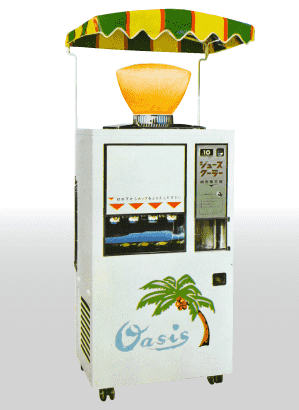
    Love me some Oasis (an old fountain-style juice vending machine brand).
    25AnonymousAug 22, 2026 09:23
    The one near me has been installed for at least two years, but they recently dropped the price to a 'trial' rate of 250 yen.
    180AnonymousAug 22, 2026 09:57
    Re: #25
    So the 'service ending' flag was already up.
    The 'trial price' is just a cover story — the real reason is clearing out stock before shutdown.
    28AnonymousAug 22, 2026 09:23
    This is the one you'd want for some nostalgic arcade-style fun.
    https://sarueglass.com/wp/wp-content/uploads/2017/12/hoshizaki01.jpg
    38AnonymousAug 22, 2026 09:25
    Re: #28
    Thought it might be a fountain-style juice machine — and it was.
    76AnonymousAug 22, 2026 09:33
    Re: #28
    10 yen a cup?
    209AnonymousAug 22, 2026 10:08
    Re: #28
    Very on-brand for Hoshizaki (a Japanese commercial kitchen-equipment maker).
    51AnonymousAug 22, 2026 09:27
    Super cold and tasty, but pricey.
    Better than Pon Juice (a famous Ehime orange juice brand).
    Went back for it a few times, but I never once saw anyone else drinking it lol.
    There's one at the Gotemba outlet mall too, and even with all the foreign tourists around, nobody was buying it.
    65AnonymousAug 22, 2026 09:31
    I can't shake the image of preservatives and fungicides getting squeezed in right along with it.
    Then again, maybe that's true of store-bought juice too.
    81AnonymousAug 22, 2026 09:35
    Re: #65
    For store-bought juice, it's probably not a case of importing preservative-treated oranges and squeezing them domestically —
    more often they're squeezed and concentrated at the source before any preservatives are even applied.
    91AnonymousAug 22, 2026 09:38
    Re: #65
    In the end, I never used one because of that.
    105AnonymousAug 22, 2026 09:41
    Pesticides, fungicides, or just plain mold — too scary to drink.
    Though price-wise it's actually cheap relative to what it costs to make.
    114AnonymousAug 22, 2026 09:43
    Re: #105
    Most of it's imported, same as lemons —
    soaked in pesticides and fungicides.
    124AnonymousAug 22, 2026 09:47
    All right then, tell me: what exactly is 'Pon Juice'?
    153AnonymousAug 22, 2026 09:53
    Re: #124
    It's Ehime's 'honest, sincere juice' (the brand's actual slogan).
    135AnonymousAug 22, 2026 09:49
    Re: #1
    I like it — it's tasty and it's a novelty.
    138AnonymousAug 22, 2026 09:49
    Never used it because I was worried about hygiene.
    155AnonymousAug 22, 2026 09:53
    Re: #138,142
    In a germophobic country like Japan, that alone is a huge hurdle.
    Makes you wonder how often they even clean the thing.
    148AnonymousAug 22, 2026 09:51
    Pricey, but it was tasty. Of course the flavor varied a bit machine to machine and by season.
    The inside looked kind of sloshy and gunky, though — hygiene status unknown.
    162AnonymousAug 22, 2026 09:55
    Re: #148
    It's kind of a mystery why people assume factory production automatically means it's hygienic, anyway.
    185AnonymousAug 22, 2026 09:58
    We've already got Juicy.

    Background and Key Points

    Fresh-squeeze “whole orange” vending machines are a relatively new import to Japan: IJOOZ machines drop two or three whole oranges into a hopper, wash and squeeze them mechanically in front of the customer, and dispense a cup for roughly 500-600 yen — several times the price of a convenience-store carton or a can of Pon Juice, the well-known Ehime-brand juice several posters compared it to. The appeal is the theater of fresh squeezing, aimed at malls, stations, and tourist spots rather than everyday grocery buying, which is why it competed against, rather than replaced, bottled juice sold in the same locations.

    The thread’s real disagreement was about cause, not fact: some posters assumed the shutdown in Tokai, Hiroshima, and Kyushu meant the machines were unsafe or unsanitary, while others (post 184) pointed out that a genuine hygiene defect would trigger a nationwide withdrawal, not a partial, region-by-region one — meaning slow sales in those specific markets is the far more likely explanation, especially given the report that at least one machine had already been discounted to a “trial” price beforehand.

    What the thread doesn’t mention is that the service is only ending in those three regions — IJOOZ machines are continuing to operate elsewhere in Japan, which readers unfamiliar with the original announcement might not realize from the headline alone. Readers should also note that the posters’ hygiene fears (mold, pesticide residue, uneven cleaning) are speculation about the internal mechanism, not confirmed reporting; the article itself cites no food-safety findings behind the closure.

    *This article is excerpted and summarized from the 5ch (News Speed+) thread “🍊Fresh-Squeezed Orange Juice Vending Machine ‘IJOOZ’ to End Service in Tokai, Hiroshima, and Kyushu.”

  • Golden Eye Snapper Caught Off Shizuoka Mislabeled ‘Product of Shizuoka’ — 5ch: ‘Fish Don’t Know Prefectural or National Borders’

    Golden eye snapper (kinmedai) caught off the coast of Shizuoka Prefecture was mistakenly labeled as a “product of Shizuoka” instead of Aichi Prefecture, home to the port where it was actually landed — and the Numazu Ganyudo Fisheries Cooperative received administrative guidance for violating the Food Labeling Act. On the thread, while some argued that breaking the law simply isn’t okay, far more commenters pointed out how hard it is to draw the line, with remarks like “fish don’t know prefectural or national borders” and “the whole idea of origin labeling is nonsense to begin with.”

    On top of that, commenters flagged that the “roughly 370,000 tons” figure cited in the original article is wildly out of line with Japan’s total annual kinmedai catch (only a few thousand tons nationwide), sparking a side discussion fact-checking the news report’s numbers themselves.

    On August 20, Shizuoka Prefecture issued administrative guidance to the Numazu Ganyudo Fisheries Cooperative for violating the Food Labeling Act, after it mistakenly told business operators that kinmedai landed off the coast of Shizuoka was a “product of Shizuoka Prefecture.”

    According to the prefecture, officials conducted on-site inspections of the cooperative three times between June 25 and August 6.

    The inspections found that kinmedai landed off the coast of Shizuoka should have been labeled for business operators using the fishing-ground name (off Shizuoka Prefecture), or, if that wasn’t feasible, the name of the landing port (Katahara Fishing Port) or the prefecture where that port is located (Aichi Prefecture) — but it had instead been mistakenly labeled as a “product of Shizuoka Prefecture.”

    Source: newsdig.tbs.co.jp / Original article here

    3AnonymousAug 22, 2026 07:43
    Re: #2
    Breaking the law is a no-no, though.
    31AnonymousAug 22, 2026 07:51
    Re: #3
    It's just a small mistake, come on.
    112AnonymousAug 22, 2026 08:18
    Re: #3
    Even if it's technically illegal, what a hassle to make a fuss over.

    As long as us poor folks get to eat, that's all that matters.
    177AnonymousAug 22, 2026 08:46
    Re: #3
    Fish don't know prefectural or national borders.
    6AnonymousAug 22, 2026 07:44
    I want to ask someone who really knows their stuff — if you had to compare this to a passage from the Heart Sutra, which part would it be???
    12AnonymousAug 22, 2026 07:45
    Re: #6
    Chanting the sutra won't fill your belly (pun on "hannya" the sutra's name and "hara," meaning stomach).
    96AnonymousAug 22, 2026 08:13
    Re: #6
    You've got to go back to the original source — the Suttanipata (the "Group of Discourses").
    8AnonymousAug 22, 2026 07:44
    So catching it off Shizuoka and bringing it into Numazu makes it a product of Aichi Prefecture?
    59AnonymousAug 22, 2026 08:01
    Re: #8
    They probably caught it off Shizuoka but landed it at a fishing port in Aichi.
    That's probably exactly why they got called out.
    35AnonymousAug 22, 2026 07:52
    Most seafood is caught "offshore" anyway, isn't it? About the only thing actually gathered right along the rocky shore is iwanori (rock nori seaweed).
    55AnonymousAug 22, 2026 08:00
    Re: #35
    Wouldn't farmed fish also get labeled as a product of whatever prefecture?
    Not 100% sure on the details though.
    37AnonymousAug 22, 2026 07:52
    Yeah, I've genuinely never seen kinmedai labeled "product of Aichi" or "product of Katahara" — labeling it "product of Shizuoka" or "Numazu" probably fetches a better price.

    I wonder if they're actually hauling it overland on purpose?
    Feels like it might just go straight to the wholesaler, kind of like dropshipping.
    45AnonymousAug 22, 2026 07:56
    Re: #37
    It really is Numazu Bay, after all.
    If a deep-sea fish like kinmedai were labeled "product of Aichi," I'd actually suspect THAT was the fake label.
    42AnonymousAug 22, 2026 07:54
    Is that right?
    Wouldn't processing it (initial prep work) in Shizuoka, even if caught off Shizuoka's coast, make it a product of Shizuoka?
    51AnonymousAug 22, 2026 07:59
    🤔
    64AnonymousAug 22, 2026 08:02
    Re: #51
    Probably did it on purpose to draw in customers.
    220AnonymousAug 22, 2026 09:06
    Re: #51
    Now on sale!
    "Domestic" eel.
    71AnonymousAug 22, 2026 08:05
    Even if they mixed up "produced in" and "caught off," what's the actual harm?
    Makes no sense to me.
    76AnonymousAug 22, 2026 08:06
    Re: #71 The difference between the fishing ground and the prefecture where the landing port is located is right there in post 1.
    77AnonymousAug 22, 2026 08:06
    Re: #71
    If it circulates labeled just "offshore," the value of the prefecture's brand name drops — that's probably why the cooperative didn't want that.
    80AnonymousAug 22, 2026 08:08
    Japan's total annual kinmedai catch, combined nationwide, is only a few thousand tons a year (roughly 3,000–4,000 tons).
    There's no way 370,000 tons of it could be sold as "product of Shizuoka."
    91AnonymousAug 22, 2026 08:11
    Re: #80 The numbers below don't add up, do they?

    > At least approximately 370,000 tons of kinmedai between April 15, 2024 and July 5, 2026.
    93AnonymousAug 22, 2026 08:12
    Re: #80
    Other outlets don't have the "10,000" (man) in the figure, so that version is probably the correct one.
    129AnonymousAug 22, 2026 08:22
    Re: #80

    Funny how Yahoo News commenters go on about the law being wrong but nobody calls out the 370,000-ton figure lol
    https://news.yahoo.co.jp/articles/dcb96c7f19d85763ae569d4e79d1c96f602b87eb/comments?order=newer

    And ironically, in another article that correctly says "36 tons," some people are deliberately inflating it to "360,000 tons."
    https://news.yahoo.co.jp/articles/f6328734195fcb1176d52e57b4eeaf5b83b03197/comments
    97AnonymousAug 22, 2026 08:14
    Might as well just label it "product of Yamanashi Prefecture" — nobody would fight over that one (Yamanashi is landlocked).
    101AnonymousAug 22, 2026 08:15
    Re: #97
    I bet Nagano Prefecture would lose it (also landlocked).
    187AnonymousAug 22, 2026 08:52
    Re: #101
    Let's just go with "Saitama Fishing Port" or something (Saitama's landlocked too).
    193AnonymousAug 22, 2026 08:55
    Re: #97
    Re: #187
    Since it's a landlocked prefecture, skip the administrative guidance and go straight to criminal penalties.
    105AnonymousAug 22, 2026 08:15
    113AnonymousAug 22, 2026 08:18
    Labeling seafood by "origin" is nonsense to begin with, right?
    Apparently they sometimes deliberately land the catch at a faraway port too.
    116AnonymousAug 22, 2026 08:19
    Re: #113
    Pacific saury, bonito — that kind of thing.
    126AnonymousAug 22, 2026 08:22
    Re: #113
    They're migratory fish to begin with, after all.
    123AnonymousAug 22, 2026 08:21
    Re: #1
    > Kinmedai landed off the coast of Shizuoka Prefecture should be labeled using the fishing-ground name (off Shizuoka), or, if that's not feasible, the landing port's name (Katahara Fishing Port) or the prefecture it belongs to (Aichi Prefecture)

    I don't really get how they're defining the terms here.
    What exactly counts as "landing" (mizuage)?
    Do they "land" it once off the coast of Shizuoka, then "land" it again at Katahara Fishing Port?
    Or does "landing" happen only once, whether it's done out at sea or at the port?
    225AnonymousAug 22, 2026 09:11
    Re: #123
    "Landing" (mizuage) basically means unloading the catch — it's what happens at the fishing port.
    227AnonymousAug 22, 2026 09:11
    Re: #123
    This article uses "landing" (mizuage) to describe both hauling the fish from the sea onto the boat (i.e., catching it) and unloading it from the boat onto the dock — which is exactly what's causing the confusion.
    That's what Professor Gemini told me, anyway.
    134AnonymousAug 22, 2026 08:24
    Honestly, at this point just label it with the exact latitude and longitude where it was hooked.
    137AnonymousAug 22, 2026 08:25
    Re: #134 That's basically the point — fishing-ground name comes first.
    205AnonymousAug 22, 2026 09:01
    Re: #134
    Listing the actual coordinates alongside it would be nice, though.

    Background and Key Points

    Japan’s Food Labeling Act (食品表示基準) treats fresh seafood differently from farmed or processed goods: wild-caught fish must carry the name of the fishing ground where it was actually caught (e.g., “off Shizuoka”), and only when that’s impractical may sellers substitute the landing port’s name or the prefecture that port sits in. Kinmedai (golden eye snapper) is a deep-water fish long associated with Numazu, a Shizuoka port city whose “Numazu kinmedai” brand commands a premium at market — which is why a cooperative there mislabeling Aichi-landed fish as “Shizuoka” reads less like consumer deception and more like brand-protection gone wrong; there was no food-safety issue, and “administrative guidance” (行政指導) is a soft compliance nudge, not a fine or prosecution.

    The thread didn’t really split over whether the mislabeling happened — that’s not in dispute — but over whether the rule makes sense at all. A small minority insisted a violation is a violation regardless of scale, but the dominant view treated prefecture-of-origin labeling for a migratory species as inherently arbitrary, since the fish itself crosses no jurisdictional lines. A separate, almost unrelated argument broke out over the article’s claim of “370,000 tons” of kinmedai, which posters correctly noted dwarfs Japan’s entire annual national catch (only a few thousand tons) — very likely a reporting error for “37 tons,” suggesting the news source itself may be less reliable than the regulatory finding it’s reporting on.

    What’s easy to miss is that “landing” (mizuage) is being used in the original notice to mean both hauling the catch aboard at sea and unloading it at port — an ambiguity in the rule’s own wording that the posters flagged but never saw officially resolved.

    *This article is compiled and summarized from the 5ch (News Speed+) thread “[Society] Kinmedai Landed Off Shizuoka Prefecture Mistakenly Labeled “Product of Shizuoka Prefecture” — Numazu Ganyudo Fisheries Cooperative Given Administrative Guidance for Food Labeling Act Violation.”